 01
01Run-Flat Replacement
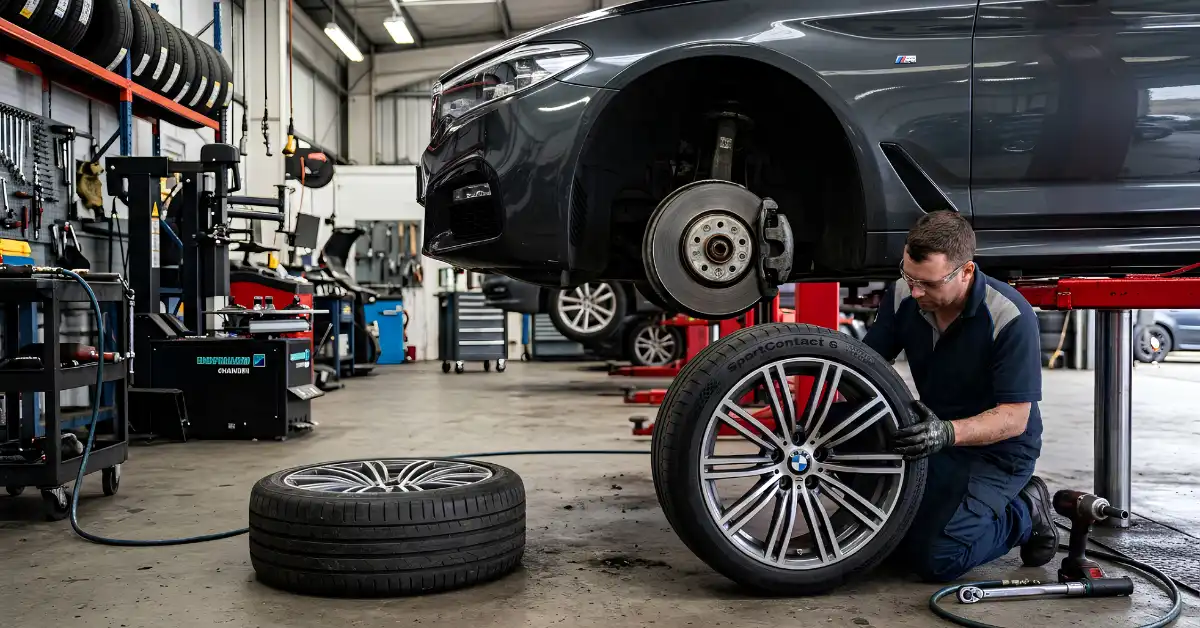
Our facility uses dedicated run-flat changers with spread clamping pressure. These safely remove and fit reinforced RSC casings without cracking the sidewall inserts.
Get a Free Written Estimate
Line-item pricing before any work begins. Call or message us now.
Call +971 52 731 8779 WhatsApp Us BMW Tyre Change · Musaffah, Abu Dhabi
800 Sayara has built a trusted reputation among vehicle owners who value precision, reliability, and clear communication. Our dedicated team treats every car with the same care that the brand itself demands, making us the preferred choice for drivers across the emirate.
Abu Dhabi’s summer temperatures exceed 48 °C, and road surfaces climb above 70 °C during peak hours. A research programme by the U.S. National Highway Traffic Safety Administration (NHTSA) found that rubber compounds in hot regions break down much faster than those in cooler areas. After just 4 years, casings in high-heat zones showed clear signs of internal wear. About 85% of related road deaths occurred in warmer states.
For a performance vehicle, this leads to 3 clear problems:
Sidewall rubber loses up to 20% of its stretch within 36 months of heat exposure. This raises the risk of blowouts at highway speeds above 120 km/h.
Tread hardening cuts wet-grip strength by 12–15% once the Shore A hardness crosses the recommended limit of 62. Hardened rubber also raises rolling resistance, which forces the drivetrain to work harder between BMW engine repair intervals.
UV-driven micro-cracking along the shoulder weakens the structure well before the tread reaches the recommended depth of 3 mm.
These factors make regular checks and timely swaps a safety-critical part of BMW ownership in the region.
01Our facility uses dedicated run-flat changers with spread clamping pressure. These safely remove and fit reinforced RSC casings without cracking the sidewall inserts.
Technicians check sensor battery life, re-register sensor IDs through iDrive or ISTA, and test low-pressure alerts across all 4 wheel spots at resting temperature.
Nitrogen molecules are larger than oxygen, so they escape through rubber 30–40% more slowly than compressed air. This keeps pressure stable longer during Abu Dhabi’s extreme summer months.
Staggered and square setups are rotated at manufacturer intervals of 8,000–10,000 km. This corrects uneven shoulder wear and extends total tread life by 15–20%.
Damaged casings are checked based on puncture location, entry angle, and liner condition. Only central-tread-zone holes smaller than 6 mm qualify for a plug repair.
Same-day swaps are available for blowouts and roadside failures. We keep OEM-spec casings from Michelin, Pirelli, Bridgestone, Continental, and Dunlop in stock at all times.
Corroded or cracked valve stems cause roughly 30% of slow-leak issues on alloy rims in coastal areas. Our team fits high-temperature EPDM valves during every installation.
Salt-air corrosion pits the aluminium bead seat over time, breaking the airtight seal between rim and casing. Wire-brush cleaning and sealant restore full contact and stop repeat pressure loss.
Our technicians carry 10+ years of hands-on experience servicing 3 Series, 5 Series, X3, X5, 7 Series, and M-Sport models across every generation.
ISTA software and OBD-II tools allow precise TPMS setup, ABS fault reading, and post-install sensor checks on every vehicle we service.
Dedicated touchless changers and spread-pressure clamping systems handle stiff RSC sidewalls safely. Most general workshops in Abu Dhabi do not carry this setup.
We collect your vehicle from your home or office anywhere in Abu Dhabi and deliver it back once the work is done. No waiting at the workshop needed.
Every quote lists casing cost, valve, balancing, alignment, TPMS service, and disposal as separate line items. No bundled charges hide what you pay.
Worn rubber, braking, steering, and alignment are all connected systems. Our facility covers all of them under one roof, so related issues get caught and fixed in a single visit.
Spotting wear early prevents costlier damage to suspension arms, wheel bearings, and steering parts. Book an inspection at 800 Sayara when you notice any of these conditions:
Shallow Tread Depth
Measure at 3 points across the tread face with a calibrated gauge, covering the inner shoulder, centre rib, and outer shoulder. Readings at or below the UAE-legal minimum of 1.6 mm confirm the tyre needs replacing. Worn tread also extends stopping distances, which puts added stress on BMW brake repair components over time.
Sidewall Cracks or Bulges
Ring-shaped cracking along the lower sidewall means the rubber is breaking down from heat and oxygen. Outward bulges show the inner layers have split apart, which cannot be fixed and needs a full swap.
Recurring Pressure Loss
Air loss greater than 0.3 bar per week goes beyond the normal rate of 0.07 bar per month. This usually points to bead-seat corrosion, a worn valve stem, or a slow puncture near the belt edge.
Steering Vibration at Speed
Shaking between 80 and 120 km/h often comes from flat-spotted tread, uneven weight spread, or a shifted belt. Run-flat casings that have rolled at zero pressure past the 80 km limit are especially prone to this.
Uneven Wear Patterns
Inner-edge feathering suggests too much negative camber or worn control-arm bushings. Centre-strip wear points to over-inflation. Outer-edge scuffing signals under-inflation or heavy cornering loads during BMW suspension repair checks.
Expired DOT Manufacture Date
Casings lose their reliability after 5 years of Gulf-region use, no matter how much tread remains. The 4-digit DOT code on the sidewall (e.g., 2321 = week 23, year 2021) confirms the production date.
Our technicians read TPMS sensor data, ABS fault codes, and wheel-speed values through BMW ISTA software before removing any wheel.
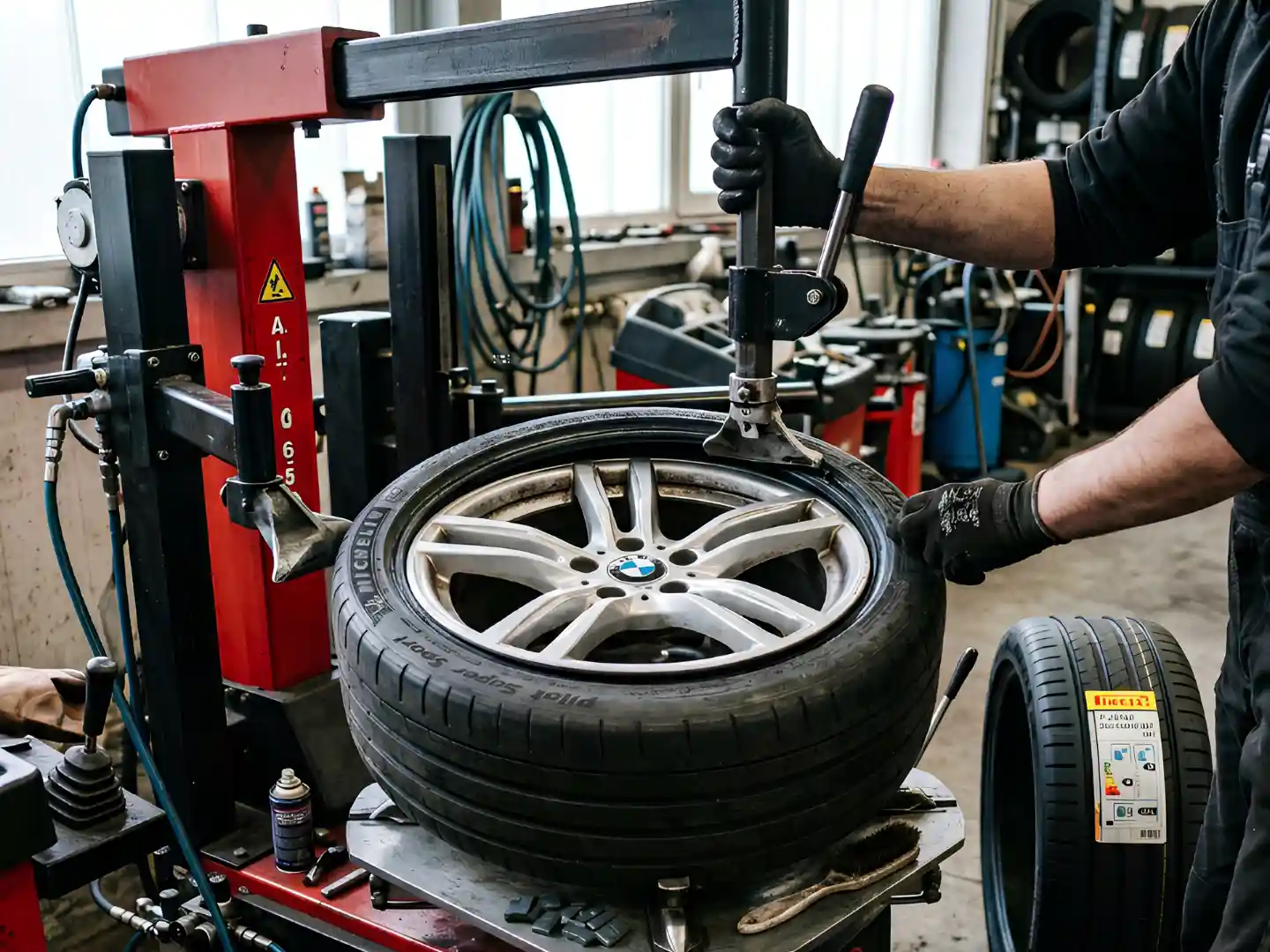
Roller-assist clamps pull the old tyre off without touching the rim lip. This protects staggered-fitment alloy wheels from bead-seat scratches and surface damage.
Every rim is checked for bead-seat corrosion, hairline cracks, lateral runout beyond 0.5 mm, and valve-bore wear before a new casing goes on.
Fresh bead lubricant seats the new casing at controlled pressure, set to the exact bar figure listed on your vehicle’s B-pillar placard.
Road-force spin balancing targets 5 grams or less of leftover imbalance per plane, followed by TPMS reset and a 120 Nm torque check on every bolt.
Fitting new rubber without checking alignment leaves it open to fast, uneven wear. A 2024 study published in the Journal of Engineering (Wiley) measured the direct link between front toe-in error and casing travel life on everyday vehicles. The results showed that even small angle shifts wear down tread well beyond normal rates.
At 800 Sayara, every installation includes a 4-wheel alignment check using a 3D camera system set to BMW’s published geometry values:
Front Camber
−1.0° to −1.5° (sedan), −0.8° to −1.3° (SUV)
Front Toe
0.05° to 0.15° total toe-in
Rear Camber
−1.5° to −2.0° (sedan), −1.2° to −1.8° (SUV)
Rear Toe
0.10° to 0.20° total toe-in
Caster
6.5° to 7.8° (model-dependent)
A front toe error of just 0.5° cuts tyre life by about 25%. That equals 10,000–12,000 km of lost tread. For drivers covering 25,000 km per year in city traffic, the replacement cycle drops from 30 months to about 22 months, adding 30–35% in extra cost over the ownership period. Our team also checks BMW steering repair needs during alignment, because worn tie-rod ends and rack bushings directly affect toe stability under load.
Contact 800 Sayara to schedule your replacement. Our service advisors confirm specifications, availability, and pricing before your appointment, so there are no cost surprises at the time of service.
800 Sayara — Al Hasheemah 4 St, Musaffah Industrial, Abu Dhabi· Mon–Sat 9:00–19:00·Open in Google Maps·+971 52 731 8779
Typical driving time to our workshop from every area we cover (tap a location to open the route):
Times are Google Maps' typical range leaving on a weekday at 11:00 AM; rush hour takes longer. Free pickup and delivery of your car is available across Abu Dhabi.
Still have a question?
Talk to a BMW advisor directly. Free written estimate before any work begins.
+971 52 731 8779 WhatsAppMost casings in Abu Dhabi last 30,000–40,000 km or 3–4 years, whichever comes first. Gulf-region heat hardens rubber and cracks sidewalls faster than moderate climates, so even sets with visible tread left lose grip sooner than the depth alone would suggest.
The UAE-legal minimum is 1.6 mm. Dropping below this can result in fines up to AED 500 and black points on your licence. The manufacturer suggests replacing at 3 mm, because wet-braking distance rises by about 30% once tread goes below that mark.
Run-flat units driven at zero pressure, even within the 80 km limit, cannot be safely fixed. Rolling while flat causes lasting damage to the stiff sidewall inserts. A run-flat that kept some air may qualify for a plug repair only if the hole is in the centre of the tread and smaller than 6 mm.
A single casing ranges from AED 450 for a mid-range 17-inch fitment to AED 2,500+ for a premium 21-inch run-flat. The per-wheel total covers the casing, valve, balancing, and TPMS reset, each shown as a separate line on your quote.
Misaligned wheels create side forces that drag the tread against the road with every turn. Research published in the Journal of Engineering (2024) showed that even small toe-angle shifts cut casing life in a measurable way. Fixing alignment at the time of fitting removes this hidden wear cause before it starts.
Not always. On a square setup where all 4 wheels share the same size, you can replace in pairs across one axle. On a staggered setup where front and rear widths differ, you must replace both casings on the same axle together. Replacing all 4 at once gives the most balanced grip and even wear, but pair replacement is fine when only one axle shows wear.
A standard 4-wheel swap, including scan, demount, mount, balance, and TPMS reset, takes about 60 to 90 minutes at our facility. Single-wheel replacements finish in roughly 30 minutes. Run-flat casings may add 10–15 minutes per wheel because the stiffer sidewalls need slower, more controlled handling on the changer.
Yes, but the switch requires a few changes. Standard casings do not support zero-pressure driving, so you will need to carry a spare wheel or a puncture repair kit. The ride will feel softer because standard sidewalls flex more than run-flat walls. Your TPMS system stays active and works the same way with either type.
 BMW Engine Repair
 BMW Transmission Repair
 BMW Brake Repair
 BMW AC Repair
 BMW Suspension Repair
 BMW Oil Change
 BMW Electrical Repair
 BMW Pre-Purchase Inspection
 BMW Steering Repair
 BMW Exhaust Repair
 BMW Window Tinting
 BMW Body Paint